
NASCAR’s Fuel Economy Run Leaves Some Feeling Empty at Daytona 500
Kevin C. Cox/Getting Images
By Dennis Krause
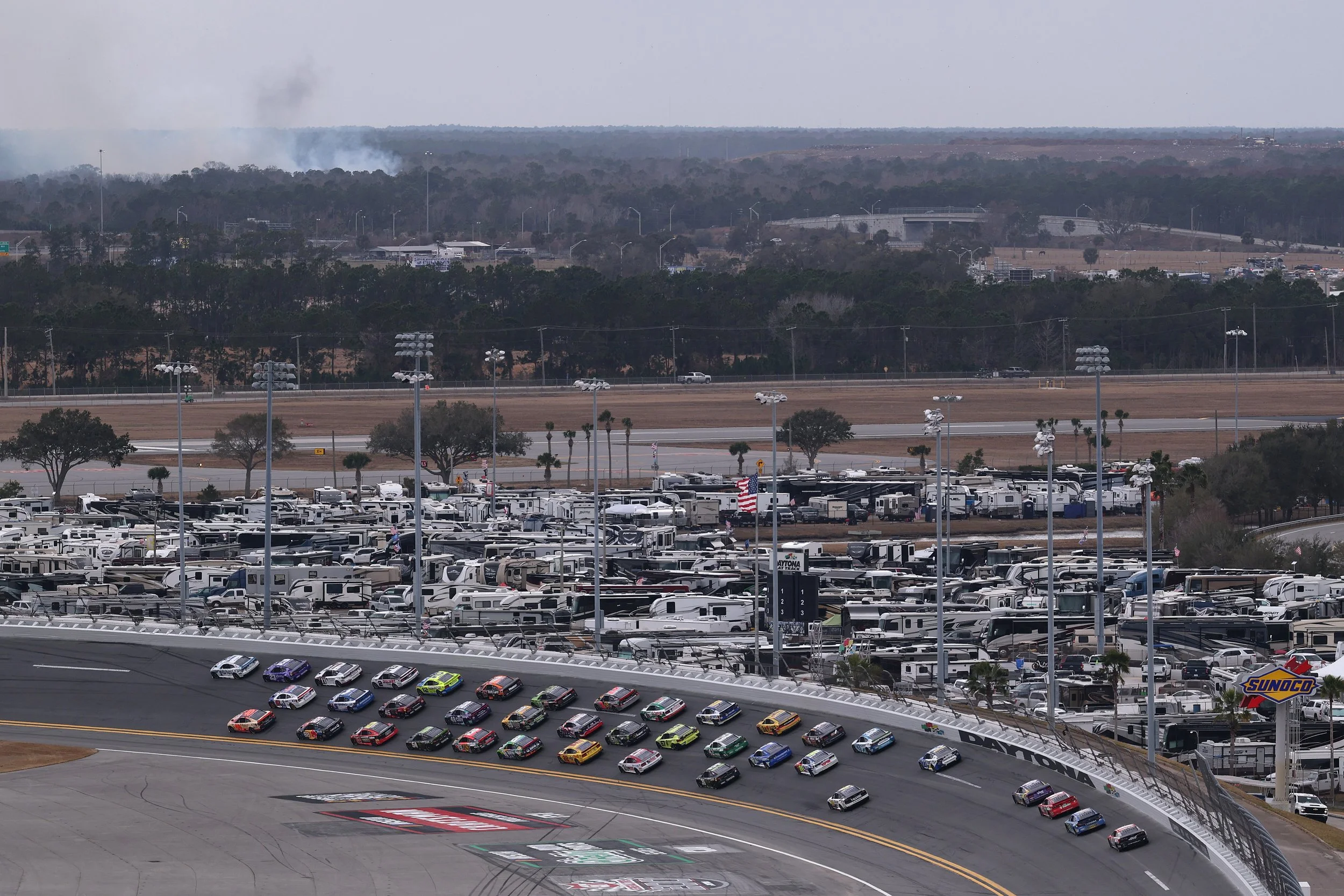
With significant green flag portions of Sunday’s Daytona 500 run at two-thirds throttle, the so-called Great American Race resembled a peloton from the Tour de France more than the stock car racing’s crown jewel event.
Because NASCAR Cup Series rules severely limit modifications teams may use on the Next Gen cars to improve performance, passing on track is compromised. Instead, teams look to gain positions by limiting their time in pit stops. By running at slower speeds, the cars use less fuel, thus shortening their time time spent stationary in the pits and gaining positions that way.
In the third, and final stage, no one wanted, or could, break free of the pack, with three Toyotas creating a virtual road block from front to back. Lap times increased by nearly several seconds around the 2.5-mile high banks of the self proclaimed World Center of Racing.
It wasn’t what the crowd estimated at 150,000 fans had come to see.
Is there anything that can, or should, be done to fix or eliminate the fuel saving gambit?
Winning crew chief for Tyler Reddick, Billy Scott, doesn’t think so.
“Well, I doubt there’s a fix to it because we’re just going to figure out the next way to exploit it, and I don’t know that it needs to be fixed.
“I think we all as competitors are spending as much time trying to figure out what the next best thing is and how to combat what each other is doing,” Scott explained. “I mean, I think it would be like asking if you need to change how chess is played. Everybody is trying to react off each other and figure out a way to get in the front at the right time. That depends on whether cautions fly, like in Stage 1 where some of them were able to stretch it all the way to the end.
“To me, from where we stand, that’s a very enjoyable part of it.”
But Denny Hamlin, co-owner of 23XI Racing, and himself a three-time Daytona 500 champion, believes there might be a solution.
“There’s a way, but we’re going to have to increase the speeds by a lot,” Hamlin said. “You’re going to have to make it to where handling matters. That’s going to spread the field. That’s going to make it to where we’re not — it’ll look a little more like racing from the past.
“But as long as (NASCAR’s) insurance company is okay with it, you’re going to have to speed up the cars because right now we’re so planted in the racetrack that we can just run in this really tight pack. One of the suggestions that we talked about just a few days ago is come here next year in the Clash. Let a few of us come up with a package that we think you won’t see any fuel saving, you’re just going to see people hanging on. That would be the only fix.”
While a pack of cars running three-wide may have provided a great visual to the casual viewer, there wasn’t a whole lot of racing going on. Second-place finisher Ricky Stenhouse Jr. acknowledged as much.
“It was brutal riding around there for a while. Not sure what the Toyota’s were doing, but I think that made the race pretty boring there for a while for the fans.”
For the sake of NASCAR’s Super Bowl, hopefully a solution can be found.
Dennis Krause has spent decades covering all forms of motorsports, including over 40 Indianapolis 500s, with stints at WIBA Radio, PIT PASS - Radio’s Premier Motorsports Magazine and Motorsports Minute. Follow him on X @DennisKrause500 or motorsportsminute.bluesky.social or motorsportsminute on Threads or MotorsportsMinute+ on Facebook.